
WHY PARENTS NEED TO BE IN THE AI CONVERSATION, NOT JUST AWARE OF IT #VPCBLOG77
I spend most of my working week inside schools helping them think through governance, strategy and the practical realities of AI. But the conversation I keep coming back to, the one I think matters most, is happening at home. It’s the one between parents and their children.
Here’s a fact that surprises a lot of the adults I talk to: children as young as five are already using AI tools. They don’t need to type. They can talk, and the tool talks back. That single detail changes everything about how we should be thinking about this. We’re used to imagining “AI use” as something that starts in high school, when a student is drafting an essay or working through a maths problem. In reality, it starts the moment a child can hold a conversation, because that’s all these tools now require.
And yet, when I look for genuinely useful guidance for parents on what good use of AI actually looks like at home, there isn’t much out there. Schools are (slowly, unevenly) building policies and practices for the classroom. Parents are largely on their own. That gap is exactly why I think councils, like the Victorian Parents Council, have such an important role to play, and why I wanted to write this piece.
Thinking with AI, and thinking around it
Young people are using AI for a genuinely wide range of reasons. Some of it is exactly what we’d hope for: using a tool to test an idea, to get unstuck on a problem, to have something to think against. Used well, AI can be a thinking partner. It can ask a good question back. It can offer a different angle a child hadn’t considered. That’s a real opportunity, and it’s one worth parents understanding and even trying themselves.
But there’s a flip side, and I don’t think we should be squeamish about naming it. Young people are also using AI to avoid thinking. To get the answer without doing the work of getting there. That is a genuine risk, and it’s not a reason to panic or to ban the technology outright. It’s a reason to have a conversation.
This is where I think parents have more power than they realise. You don’t need to understand the technology to ask your child a simple question: “Did you think that through yourself, or did you get AI to do it for you?” Asked with curiosity rather than suspicion, that question does two things. It signals to your child that the process matters as much as the outcome. And it opens a door to talk honestly about when using AI to think is smart, and when it’s a shortcut that costs them something.
The conversations children are having with machines
There’s a part of this that concerns me more than homework shortcuts, and it’s one I think parents need to hear plainly. Young people aren’t only asking AI to help with schoolwork. They’re asking it questions about themselves. About their friendships, their worries, their future, who they are and where they’re headed. Some are turning to AI in moments that look a lot like therapy or companionship.
I understand why. These tools are always available, they never sound impatient, and they respond instantly. For a child working through something difficult, that can feel like relief. But a child’s sense of who they are, and their capacity to sit with uncertainty, is built through real relationships. Through a parent who listens, who sometimes doesn’t have the answer, who stays in the room. That is not something a chatbot can replace, no matter how warm its responses sound.
This is not a call to monitor or restrict every conversation your child has with an AI tool. It’s a call to stay close. To keep asking the questions you’d naturally ask anyway: how was your day, what’s on your mind, what are you worried about at the moment. If your child is bringing those questions to a machine instead of to you, the answer isn’t to take the machine away. It’s to make sure you’re still the first and best place they bring them.
Parents as active partners, not bystanders
The good news is that parents don’t need to become AI experts to be useful here. What you model at home matters more than what you know about the technology. If your own relationship with screens and AI tools is thoughtful and visible, that teaches something. If a child sees an adult use AI as one tool among many, rather than reaching for it reflexively for every question, that’s a genuine lesson in judgement.
The other thing I’d encourage every parent to do is ask about process, not just product. When your child brings home a piece of work, the most useful question isn’t “is this good?” It’s “how did you get here? Walk me through it.” That question works whether or not AI was involved at all, and it quietly reinforces that the thinking is the point, not just the finished page.
None of this requires you to become a technologist. It requires you to stay engaged, stay curious, and stay present, in exactly the way good parenting has always required. AI hasn’t changed that job. It’s just made it more urgent that we do it well.
Start human. Use AI. Stay human. That applies at the kitchen table just as much as it does in the classroom.
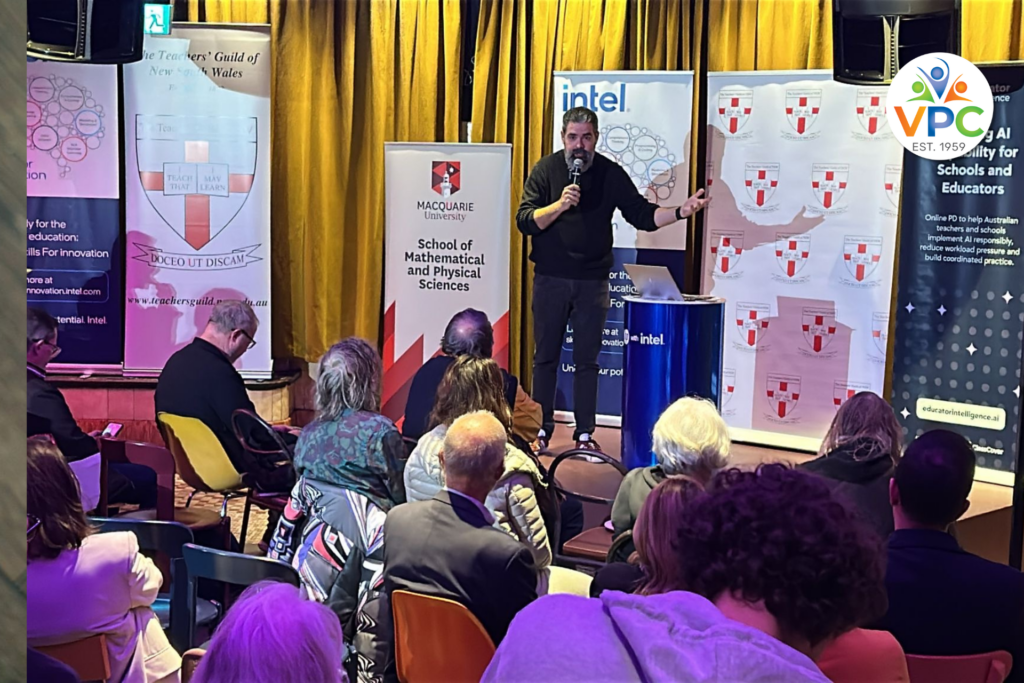
Matthew Esterman is the founder of The Next Word and co-founder of Educator Intelligence. A history teacher for nearly two decades and former Director of Innovation and Partnerships, he now helps schools across Australia take confident, safe and human centred next steps with AI. His motto: start human, use AI, stay human