
WELLNESS SERIES: LOOKING BEYOND BEHAVIOUR: UNDERSTANDING THE CAPACITY BEHIND SCHOOL ATTENDANCE
In a recent blog, I explored how behaviours such as tantrums or meltdowns are often signs that a child’s regulatory capacity has been exceeded. When a child is overwhelmed, what looks like “bad behaviour” may be a nervous system struggling to cope.
The same concept can be used to understand another challenge many families face; which is difficulties with school attendance.
When a child begins to struggle with attending school, it is natural as a parent to question the behaviour you are seeing in front of you. Are they sick? Are they refusing? Avoiding? Being oppositional or demanding? Another natural response, as a parent, when it is unclear, is to encourage them to go, and there are degrees of ‘encouragement’ that we have all used. Sometimes, in our haste to resolve the situation, an important question can be missed. What if the issue is less about behaviour and more about capacity?
Shifting the Lens
A behaviour lens focuses on the question: How do we change the behaviour?
A capacity lens asks a different question: What might be reducing this child’s ability to meet the demands of attending school right now?
Behaviour is an outward expression of an internal state, and that state shifts along a continuum from “I feel safe” to “I feel unsafe or I am not sure.”

Like you, your child moves along this continuum throughout the day, depending on the demands placed on them and the stress they are carrying. At times, they may feel settled and able to engage. At other times, their system may be signaling stress, uncertainty or overwhelm.
This shift in perspective can change how we understand attendance difficulties and how we respond to them.
Understanding Capacity
Capacity can be thought of as your child’s current ability to manage the demands placed upon them. They include:
- social interactions
- transitions and separation
- sensory environments
- internal thoughts and feelings
Capacity is a flexible range rather than a fixed point. It fluctuates in response to a range of interacting factors, including:
- developmental stage
- sleep and physical health
- relational safety and support
- accumulated stress or adversity
- environmental demands and new experiences
- previous experiences of success or threat
Capacity is not just functional; it also has a felt sense. When capacity is lower, your child is more likely to feel uncertain or under threat.
Connecting This to You
You may recognise this from your own experience of managing stressful situations. Just as your capacity can shift and change across the course of a day or week or month or more, so too does your child’s capacity.
Take a moment to notice your own state right now. How are you feeling?
- Calm and settled
- Irritable and frustrated?
- Overwhelmed?
- Exhausted?
How you are feeling reflects how much load your nervous system is carrying, and how much capacity you have available to adequately manage what’s being asked of you.
Your child operates with the same system. The difference for them is not the ‘hardware’ but their level of development and experience in managing it.
Capacity and Stress Load
Capacity is closely linked to stress load, which is the amount of pressure on a nervous system to remain stable. The brain and body are constantly monitoring internal and external conditions. When something feels uncertain, overwhelming, or threatening, the stress response system becomes more active.
This response is helpful in many situations because it prepares the body to cope with something new by increasing alertness and prioritising safety.
However, as stress increases, a line is crossed and the brain begins to allocate its resources differently. It becomes much harder to e.g.:
- think clearly
- stay flexible
- problem-solve
- regulate emotions
- engage in learning
When a child’s nervous system shifts into this protective mode, the systems that support reasoning, flexibility, learning and emotional regulation become less accessible (Porges, 2022).
When Capacity is Exceeded
As stress load increases, you may notice your child:
- struggling to concentrate
- becoming more emotionally reactive
- finding it hard to sit still
- appearing fatigued or shut down
- avoiding tasks that were previously manageable
A child who was able to attend school consistently may begin to struggle if their overall stress load has increased. From this perspective, attendance difficulties are not simply defiance or avoidance. They may be a signal that your child’s internal resources are temporarily exceeded. Behaviour, in this sense, becomes communication of reduced capacity.
Stress and the Tipping Point
While the gradient above shows how your child’s state can shift moment to moment, the pattern below helps explain what happens as stress continues to increase over time.
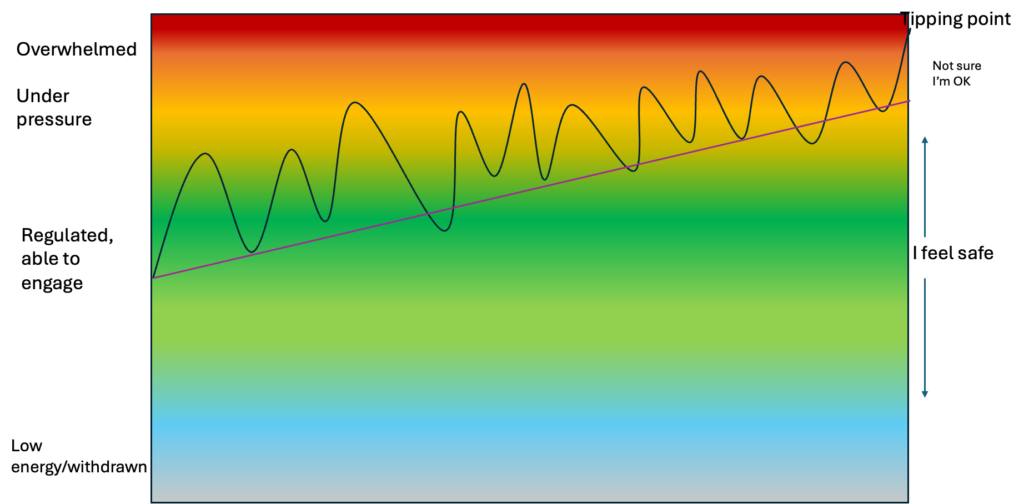
As stress increases beyond a manageable range, the capacity available for learning and regulation diminishes (Blair & Raver, 2016).
For some children, this tipping point is reached more quickly due to factors such as anxiety, developmental stage, learning challenges, or previous experiences of stress. When stress accumulates over time, the nervous system may not fully return to its usual baseline. This means that everyday demands can begin to feel more effortful, even if nothing obvious has changed.
When this happens, behaviour that may seem confusing, disproportionate, or difficult to understand, can emerge.
What Helps Restore Capacity
A capacity-informed approach does not remove expectations. It aligns them with what a child can realistically manage in that moment.
Two key processes support the restoration of capacity:
1. Reducing pressure (temporarily) to stabilise.
This may involve adjusting demands or providing additional support so the nervous system can return to a more regulated state.
In practice, this can look like breaking a larger goal into smaller, more manageable steps that build on each other over time. As children experience success at each stage, their confidence and capacity gradually increase.
2. Build capacity from their strengths
Capacity grows when children experience success, safety and connection. Small wins, positive reinforcement, and supportive relationships help rebuild confidence and increase tolerance for further challenges.
Applying This to School Attendance
Attending school requires children to manage a complex set of demands, including:
- separation from caregivers
- navigating peer relationships
- sustained cognitive effort
- sensory environments such as noise or crowding
- performance expectations
- fatigue across the school week
Most children can manage these demands when their capacity is sufficient. However, when stress load increases and is sustained, these same demands can begin to exceed what the child can manage.
Attendance patterns can therefore be understood not simply as behaviour, but as signals about the interaction between stress and capacity.
Final thought.
Sometimes the first step is not getting back to full attendance straight away but understanding what needs to shift so that attendance becomes possible again. When we shift from a behaviour lens to a capacity lens, we can have a different conversation. Instead of asking “why won’t my child go to school”, we can ask “what might be making attendance hard right now.” This begins a process of exploration and seeking to understand what they are finding difficult right now.
From here, small, supported changes become possible and achievable. Each small ‘win’ becomes a foothold for them to further build their capacity. As capacity builds, behaviour will follow.
References
Blair C, Raver CC. Stress and the development of self-regulation in context. Child Dev Perspect. 2016;10(3):181–188.
McEwen, B. S., & Akil, H. (2020). Revisiting the stress concept: Implications for affective disorders. Journal of Neuroscience, 40(1), 12–21.
Montroy, J. J., Bowles, R. P., Skibbe, L. E., McClelland, M. M., & Morrison, F. J. (2016). The development of self-regulation across early childhood. Developmental Psychology, 52(11), 1744–1762. https://doi.org/10.1037/dev0000159
Porges, S. W. (2022). Polyvagal safety: Attachment, communication, self-regulation. W. W. Norton.
Shanker, S. (2016). Self-Reg: How to help your child break the stress cycle and successfully engage with life. Penguin.
Whiting, S. B., Wass, S. V., Green, S., & Thomas, M. S. C. (2021). Stress and learning in pupils: Neuroscience evidence and its relevance for teachers. Mind, Brain, and Education, 15(2), 177–188.
Katrina Gow is a counsellor and psychotherapist in private practice in Melbourne, working with parents, caregivers, and adults navigating complex life situations. Her practice, The Slow Work, draws on nervous system science, embodied awareness, and thirty years of Iyengar yoga practice to support people through stress, burnout, and the particular demands of raising children in demanding times. She serves as an advisor on the Deakin University School Attendance Project and writes regularly for the Victorian Parents Council on parent wellbeing, capacity, and family stress. www.theslowwork.com.au