

WELLBEING SERIES: YOU HAVE A CAPACITY TOO: WHY YOUR WELLBEING MATTERS MORE THAN YOU THINK
It is Monday morning.
Your child is under the doona, saying they feel sick. They have been saying this a lot lately, and over the past month have not managed a full five-day week of school.
You tell them there is nothing wrong and that they need to get up, but they snap back and dive further under the doona.
You feel it almost immediately: a grip at the back of your throat and a tightness in your chest as your frustration begins to rise.
Within minutes, things escalate. Your ability to be the calm, supportive parent you want to be starts to slip away as your carefully planned day begins to unravel. Phone calls follow. Appointments are reshuffled. You find yourself apologising and explaining why you cannot make it again.
If this feels familiar, rest assured you are not alone. Moments like this place a significant load on your system. It is not just the practical disruption to your day, but the emotional weight of it all: the worry about what is going on, the uncertainty of not having answers, and the frustration of repeatedly trying things that do not seem to work.
Over time, these moments do not just pass. They accumulate. You may not notice this at first because the signs can be subtle and get mixed up with the busyness of parenting and life. However, if left unattended, you may find yourself operating with a much shorter fuse, feeling constantly on edge, wired, exhausted, irritable, or simply running on empty.
Things that once felt manageable can start to feel disproportionately hard. This is not a reflection of your parenting or your intentions. It is a reflection of your capacity.
Capacity can be thought of as the space you have to manage the demands placed upon you, and it is driven by a feeling. That feeling comes from your stress response being activated. Like your child, your capacity is not fixed. It shifts throughout the day and is influenced by factors such as sleep, stress, emotional load, workload, physical wellbeing, and the level of support around you.
The Tipping Point
Everyone has a tipping point. This is where the load on your system exceeds what you can comfortably manage. What this looks like will be specific to you but may include:
- ‘Losing it’ completely
- Walking out of the house and slamming the door in response to a request
- Yelling and screaming
- Saying things, you later regret
- Negative thoughts like; “I can’t take this anymore.”
Knowing what your tipping point looks like is important information about the load your system is carrying. The key is understanding how close you are to that point.
The graph below offers a way of visualising this.
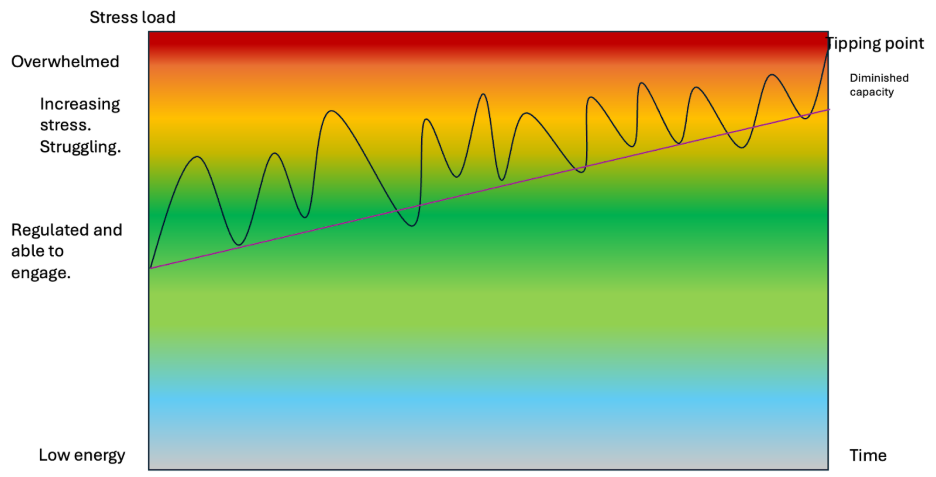
The green area represents a range where your system has enough capacity to manage what is being asked of it. Within this space, you are more able to think clearly, stay flexible, and respond in a way that aligns with how you want to parent. The purple line is your baseline, and this is the flexible part that can move in either direction to increase or decrease your capacity.
It is hard to notice how stress increases over time because it often gets absorbed and blended with everything else in life. It is frequently only when something substantial demands your attention such as a health crisis, a relationship under strain, that you have the opportunity to pause and reflect on what is going on. That demand is felt as rising stress levels, which affect your capacity and influence how you feel, behave, and think.
As you edge toward your tipping point, your system shifts into a more urgent state. The focus becomes getting through the moment, rather than responding calmly or thoughtfully.
Capacity is not something you either have or don’t have. It is something that can be supported and adjusted in response to what is happening around you. Building capacity often begins with small, manageable shifts, along with noticing what helps, allowing rest, and repeating this over time.
The role of self-care
Self-care can sometimes sound like indulgence. It is often described as taking some time out to support your physical and mental wellbeing through things like exercise, nutrition, sleep, and connection.
From a capacity perspective, self-care is about restoring your system so it can recover from ongoing demands, rather than continue to accumulate them. In this sense, self-care is not just about you, as it also supports the people who depend on you as well. It can be thought of as family care.
Capacity and care exist in a feedback loop. The more capacity you have, the easier it is to engage in self-care. When capacity is low, it can feel much harder to find the time, energy, or headspace, even though this is when you need it most.
How to self-care when you don’t feel like it
When your capacity is low, even thinking about change can feel like too much. This is where small, achievable steps become important. These steps begin the process, even when the destination feels far away.
- Start with a direction
While it can help to have a picture in your mind of how you want things to look, it is just as important to have a sense of how you want to feel. How you feel strongly influences your thinking and behaviour.
You might try:
“I would like to feel a little calmer about my life.”
“I would like to feel more energetic.”
“I would like to feel different to how I feel right now.”
2. Aim for a gentle upward spiral, eventually
Progress is not a straight line. It is more like a spiral staircase, and not always a tidy one.
There will be stops and starts. There will be days when things feel easier and others when it feels like you are back where you began. You may restart the same intention more than once. These stops and starts and retries are exactly what doing something differently feels like, so don’t be discouraged if it isn’t smooth sailing.
The spiral moves upward over time, even when it does not feel that way in the moment. The steps have room for you to sit, catch your breath, and look back at what you have already climbed. Progress is often only visible in hindsight.
3. Take one small, possible step
The step doesn’t need to be big, just doable.
A breath. A stretch. Noticing something around you. Reaching out to someone.
When your system is under load, it doesn’t need more, it needs less, done intentionally and consistently.
Final thoughts
Understanding your own capacity is about noticing the load you are carrying, recognising when your system is under strain, and making small changes where you can. It is never about getting it right, but learning what works and what doesn’t, and making small, regular, and considered adjustments along the way. When you begin to see yourself through this lens, it becomes easier to meet yourself with a little more understanding and a little less judgment.
Importantly, this is the same system your child is relying on, too. The fluctuations, the tipping points, and the need for recovery are shared experiences, not separate ones.
In the next blog, I will explore how this understanding can help make sense of school attendance difficulties, and why behaviour that looks like resistance may, in fact, reflect a child whose capacity is under strain.
References
- McEwen BS. Stress, adaptation, and disease: allostasis and allostatic load. Ann N Y Acad Sci. 1998;840:33-44. doi:10.1111/j.1749-6632.1998.tb09546.x Link
- Frodl T, O’Keane V. How does the brain deal with cumulative stress? A review with focus on developmental stress, HPA axis function and hippocampal structure in humans. Neurobiol Dis. 2013;52:24-37. doi:10.1016/j.nbd.2012.03.012 Link
- Roskam I, Aguiar J, Akgun E, Arikan G, Artavia M, Avalosse H, et al. Parental burnout around the globe: a 42-country study. Affect Sci. 2021;2(1):58-79. doi:10.1007/s42761-020-00028-4 Link
- Ren Z, Zhou Q, Ma Y, Xiong M, Li Y, Shi X, et al. A systematic review of parental burnout and related factors among parents. BMC Public Health. 2024;24:376. doi:10.1186/s12889-024-17904-0 Link
- Hosokawa R, Katura T. Association among parents’ stress recovery experiences, parenting practices, and children’s behavioral problems: a cross-sectional study. BMC Psychol. 2025;13:198. doi:10.1186/s40359-025-02453-1Link
Katrina Gow is a counsellor and psychotherapist in private practice in Melbourne, working with parents, caregivers, and adults navigating complex life situations. Her practice, The Slow Work, draws on nervous system science, embodied awareness, and thirty years of Iyengar yoga practice to support people through stress, burnout, and the particular demands of raising children in demanding times. She serves as an advisor on the Deakin University School Attendance Project and writes regularly for the Victorian Parents Council on parent wellbeing, capacity, and family stress. www.theslowwork.com.au