
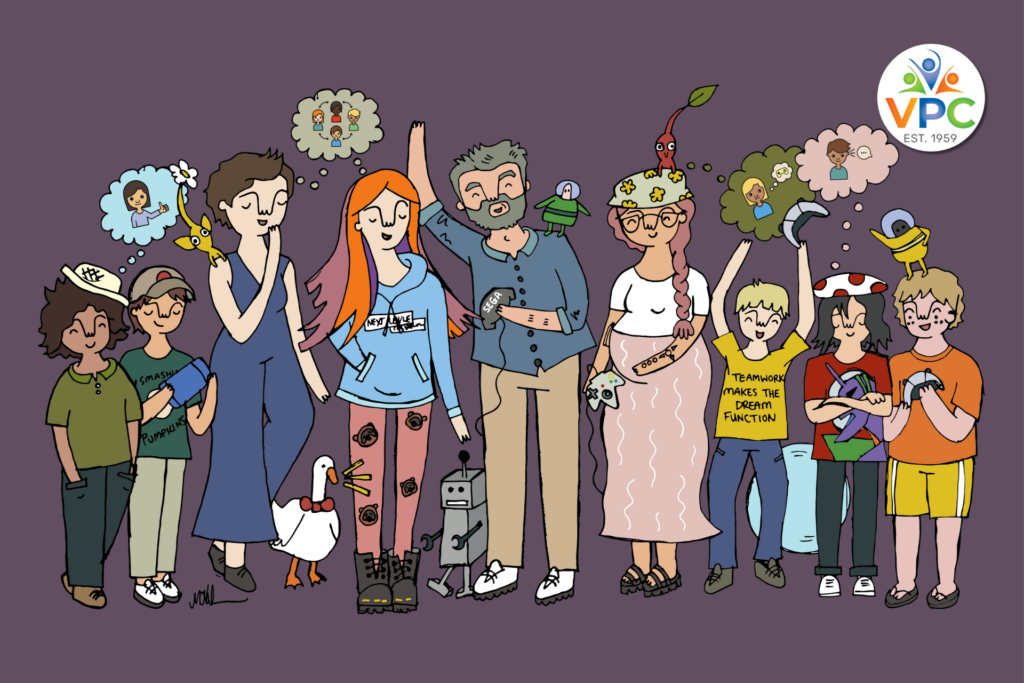
GAMING IS GOOD: HOW COOPERATIVE VIDEO GAMES CAN BRING FAMILIES TOGETHER #VPCBLOG74
Few topics spark stronger opinions among parents than video games. For some families, games are a source of worry, conflict and negotiation. For others, they are a much-loved hobby and a way to relax, compete, create and connect. The research on gaming reflects this complexity (we suggest checking out the analysis of Dr. Rachel Kowert for more about this). It does not tell us that games are simply “good” or “bad” for children. Instead, it shows that gaming experiences vary widely, depending on the game being played, who children are playing with, how the activity is supported, and how gaming fits within the broader rhythms of family life.
At Next Level Collaboration, we have a particular interest in cooperative video games. These are games where players need to work together as a team to solve problems, share resources, communicate clearly and achieve a common goal. Rather than focusing on winning against one another, cooperative games can create opportunities for players to practise collaboration in a playful and motivating way.
Next Level Collaboration works with families from across Victoria through our NLC Lab, delivered in person, and our online SafePlay programs. We often talk with families about how team-based gaming is already being used in their homes to build positive relationships between family members, create dedicated family time and develop collaborative problem-solving skills. For many families, gaming is not replacing connection; it is becoming one of the ways connection happens.
Our stories
For both of us, gaming has been much more than entertainment. As neurodivergent people, video games have been important spaces where we could connect with others through shared interests, develop confidence and build lifelong friendships.
Matthew’s research began from a simple observation as a teacher: when young people are doing something they genuinely enjoy, their strengths often become much more visible. In structured cooperative gaming environments, children and young people can show leadership, humour, persistence, creativity and care for others. They can plan together, recover from mistakes together and celebrate success together. These are not small things, but rather the building blocks of friendship and belonging.
Jess brings her experience as an AuADHD (both autistic and ADHDer) speech pathologist and researcher, as well as her deep commitment to neurodiversity-affirming practice. In simple terms, this means supporting neurodivergent children to be themselves, rather than asking them to hide or change the ways they communicate, play or relate to others. For many neurodivergent people, gaming communities can provide a shared language. You do not always have to begin with stilted small talk. You can begin with the game, a shared goal, characters, lore or the shared joke that emerges during play.
This is one of the reasons cooperative gaming can be so powerful – social interaction is embedded in the activity. Children are not being asked to “perform” skills in isolation. They are using communication and problem-solving because the game gives them a real reason to do so. For families, this can shift the focus from “How do I get my child off games?” to “How can we make gaming a healthier, more connected and more positive part of family life?”
What about the concerns?
Of course, many negative stories about gaming in the home are real and familiar. Parents may worry about arguments when it is time to stop, children becoming upset after losing, online safety, sleep disruption, aggressive behaviour, or gaming crowding out homework, physical activity and time with family. These concerns should not be dismissed.
The key point is that gaming needs to be positioned as one part of a balanced lifestyle. Time limits are a good thing. Australian guidelines recommend that children and young people aged 5 to 17 have no more than two hours per day of sedentary recreational screen time, not including schoolwork. Families will interpret and apply this in different ways, but the principle is useful: gaming should sit alongside sleep, movement, school, outdoor play, face-to-face relationships, family responsibilities and downtime away from screens.
It is also important to remember that not all gaming is equal in the quality of experience it creates. A child playing alone for hours in an unmoderated online space is having a very different experience from siblings, cousins or parents sitting together and solving problems in a cooperative game. The question is not only “How much screen time?” but also “What kind of screen time, with whom, and for what purpose?”
Three couch co-op games we often recommend as starting points for families are Untitled Goose Game, Rayman Legends and Lovers in a Dangerous Spacetime. Untitled Goose Game is playful, funny and mischievous, with opportunities for shared problem-solving and laughter. Rayman Legends is a colourful, fast-paced yet accessible platform game, encouraging players to support one another through varied challenges. Lovers in a Dangerous Spacetime is a wonderful example of genuine teamwork, as players run around a spaceship managing shields, weapons and engines while trying to survive together. These games can create the conditions for communication, turn-taking, planning and shared joy, especially when adults participate as co-players rather than supervisors hovering nearby.
Practical tips for parents
First, play together before making rules from a distance. Sitting beside your child and learning the game can change the conversation. It allows you to see what they enjoy, what frustrates them, how they solve problems and how they respond to success and failure.
Second, choose games intentionally. Look for cooperative games where players share a goal, help each other and can pause when needed. For younger children, avoid games with unmoderated voice chat or online interaction with strangers. Couch co-op, where players are in the same room, is often a safer and more relationship-focused place to begin.
Third, make expectations predictable. Many conflicts happen because the end point is unclear. Agree on when gaming will start, when it will finish and what needs to happen before play begins. A visual timer, a “last level” warning or a clear routine can make transitions easier.
Fourth, focus on the quality of the interaction. After playing, ask questions such as: What worked well as a team? When did we communicate clearly? What was tricky? What could we try differently next time? This turns gaming into an opportunity for reflection without turning it into a lecture.
Fifth, model healthy habits. Children notice whether adults also struggle to put devices away. Family gaming works best when it is part of a shared culture of balance, where everyone has screen-free times, outdoor time, rest and responsibilities.
Finally, stay curious. For many children, especially neurodivergent children, games are not “just games”. They can be places of mastery, identity, friendship and belonging. When parents take children’s gaming interests seriously, they open a door to connection.
Gaming will never be the right fit for every family, every child or every moment. But when chosen carefully, bounded clearly and played together, cooperative video games can be much more than screen time. They can be shared time, relationship time and a surprisingly powerful space for families to practise working together.
Associate Professor Matthew Harrison is an educator, researcher and digital creator at the University of Melbourne whose work focuses on neurodiversity, inclusive education and the use of digital technologies to support belonging and social connection. He is a founding member of the University’s Neurodiversity Project and co-founder of Next Level Collaboration, a social enterprise using cooperative video games to build confidence, collaboration and social capabilities for neurodivergent young people.
Contact: [email protected]
Jess Rowlings is the CEO and co-founder of Next Level Collaboration, a qualified speech and language pathologist, and an Honorary Enterprise Fellow at the University of Melbourne. Her work brings together neurodiversity-affirming practice, lived experience and digital games-based learning to create inclusive spaces where neurodivergent young people can build confidence, connection and collaborative skills.